Thomas Tuchel choked, and England paid the price
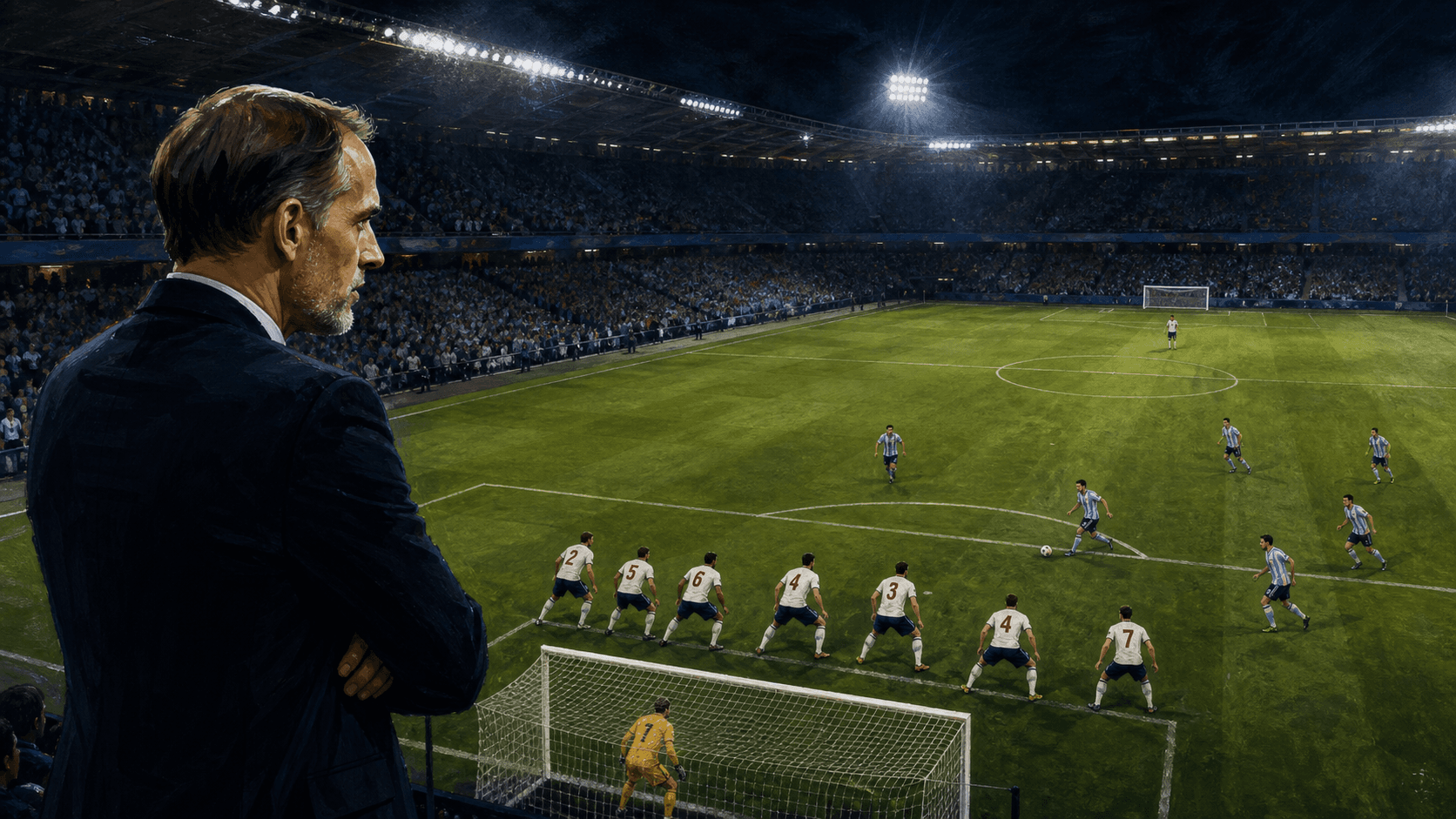
England were 1-0 up in a World Cup semi-final with 18 minutes to play. Argentina were rattled. Their centre-backs were booked. Anthony Gordon had just scored, Morgan Rogers was carrying a threat on the break and Declan Rice had created the goal by winning the ball and moving it forward quickly.
Then Thomas Tuchel decided that England's route to the final was to stop playing football.
Argentina won 2-1. Enzo Fernández equalised in the 85th minute. Lautaro Martínez scored the winner in the 92nd. The bare scoreline looks like another cruel England defeat at the sharp end of a tournament. It was not. This was a managerial collapse, visible to almost everyone watching while it happened.
The first warning came in the 72nd minute, when Tuchel replaced Gordon with Ezri Konsa. It was a bad change, but at least it was understandable. Argentina had responded aggressively to falling behind. England were being pushed back and Tuchel wanted a fifth defender to help deal with the crosses.
But Gordon was also England's best outlet. He had the pace to make Argentina turn around, and he was the player who had just punished them. Taking him off told Argentina that there would be no price for committing more bodies forward.
The match really became irretrievable ten minutes later.
The 82nd minute changed everything
With England already pinned back, Tuchel removed Rice and Reece James for Nico O'Reilly and Dan Burn. England now had five centre-back or full-back types in the back line, with another defender-by-trade in midfield. Call it a back five, a back six or a 5-4-1. The label hardly matters. The function was obvious: survive.
But survival requires some way to keep the ball. Burn is an excellent specialist defender. Konsa is an excellent defender. Neither is there to receive under pressure, dribble through midfield or connect with Kane and Bellingham. England had loaded the pitch with players chosen to repel attacks while removing the players capable of stopping those attacks from returning.
Three minutes later, Fernández stood outside the box with nobody close enough to block the shot. Would Kobbie Mainoo definitely have stopped it? Nobody can know. But a fresh central midfielder whose instinct is to occupy that space, take the ball and play through pressure was exactly what England needed. Mainoo did not play a single minute at the World Cup.
That is the absurdity. Tuchel sold the squad as having "specialists for every situation", with defined roles and a balanced group. Mainoo was supposedly the like-for-like midfield specialist. If his speciality was not needed when Rice was exhausted, England could not keep possession and Fernández was repeatedly finding space in front of the defence, what possible situation was he selected for?
Coaches' Voice recorded Argentina having more than 80% possession after England scored. From Gordon's goal until Martínez's winner, England had just 12%. This was not a narrow tactical gamble undone by one moment of Messi genius. England abandoned the ball for nearly 40 minutes and invited the world champions to attack until something broke.
As one supporter, u/Adnan7i, put it in the immediate post-match reaction: "At one point they had only Harry Kane on as an outright attacking player". On Rio Ferdinand's post-match show, @girithesan found the brutal summary: "When in trouble, Argentina turn to Messi. When in trouble, England turn to Dan Burn."
Defending is not only about adding defenders
The idea that an attacking substitute would have been reckless gets the game completely backwards.
Bring on Bukayo Saka, Noni Madueke or Eberechi Eze and Argentina have to defend them. Leave Rashford high and their back line cannot stand on the halfway line without fearing the space behind. Put Mainoo in midfield and England have another player who can receive a pass rather than return the ball immediately. Fresh attackers do defensive work simply by forcing the opponent to respect the counterattack.
Instead, Argentina's rest defence shrank to an aggressive 2-1. They could send almost everyone forward because England had no credible transition threat. Tuchel did not make England safer. He removed the only thing making Argentina cautious.
The contrast with Lionel Scaloni could not have been clearer. Argentina were losing, so Scaloni replaced the defensive Paredes with Nico González and then, in the 81st minute, removed the left-back Tagliafico for Lautaro Martínez. One manager used his bench to change the momentum. The other used his to surrender it.
Even after Fernández made it 1-1, Tuchel did not reverse course. That was the final chance to admit the plan had failed. There were still Saka, Eze, Madueke, Rashford, Toney and Watkins on the bench. England could have restored width, carried the ball up the pitch and made Argentina worry again.
Nothing changed. England stayed deep. Mac Allister hit the post. Messi crossed for Lautaro. Only after Argentina went 2-1 ahead did Tuchel finally reach for Rashford and Toney, and even then he waited until the 96th minute. They replaced Stones and Spence with six minutes of added time already gone.
It solved none of the core problem. Strikers cannot rescue a team if nobody can get the ball to them. England needed midfielders and dribblers before they needed another target in the box.
By the end, England's creative plan was Jordan Pickford launching the ball towards Burn and Toney. When the goalkeeper is being asked to provide the assist because there are no midfielders left to advance the ball, something has gone dreadfully wrong.
Tuchel ignored his own blueprint
England had already shown how to manage this kind of game against Croatia. When the wide attackers tired, Tuchel replaced them with fresh attacking energy. The shape remained coherent, the opposition still had to defend and England kept a route up the pitch. Like-for-like changes are not timid. In the right game state, they are how a team maintains its intensity.
Spain offered the same lesson in the other semi-final. They led France 1-0, kept playing and finished with a 2-0 win. They defended with the ball and with the continuing threat of a second goal. England treated a one-goal lead as an emergency to be protected rather than a platform from which to win.
There had been warning signs throughout the tournament. A semi-final sounds impressive, but England looked weak against Norway and needed extra time. Mexico was a difficult match, although playing with ten men at the Azteca makes that understandable. The opening win over Croatia showed the potential of this squad; too many of the games that followed showed a team without a settled attacking identity.
The squad debate will now return. Leaving Phil Foden and Cole Palmer at home was questionable. Taking 36-year-old Jordan Henderson was worse, and his broken wrist left Tuchel without the veteran option he had trusted over younger midfielders.
But the squad omissions do not excuse the semi-final. Tuchel had Mainoo and Eze in Atlanta. He had Saka and Madueke. He had Rashford. The players required to change the game were sitting a few metres away. The failure was not that England had no alternatives. It was that the manager refused to use them until the match was gone.
This was worse than the mistakes Tuchel was hired to fix
England under Gareth Southgate could be maddeningly conservative, but even in defeat they often seemed to have one more chance in them. In the Euro 2024 final against Spain, England forced a desperate goal-line clearance late on. They lost, but they reached the opponent's box with the game alive.
Tuchel's England could not produce that final chance against Argentina because Tuchel had taken away the structure needed to create it.
Harry Kane admitted afterwards that England "seemed to just try and hold on", adding that at this level it was not enough. Tuchel acknowledged that England became passive, yet defended the logic of the substitutions and declared that he had "no regrets".
That is not accountability. It is arrogance dressed up as analysis. Saying "the responsibility is on the coach" means little when it is immediately followed by an explanation of why every decision was reasonable. The job is not to produce a defensible theory after the game. The job is to recognise, in real time, that the theory is failing and change it.
It was obvious in real time. The match threads were screaming for an outlet. The television analysts were asking where the midfield had gone. A Tifo discussion watched by more than 100,000 people began dissecting the retreat almost as soon as the whistle went. On talkSPORT, @AmenHeavy captured the anger: "If we die on our sword, we'd all accept it. Hiding under our shield was disgraceful."
Tuchel froze under pressure. He did not think quickly enough to course-correct at 1-1. He repeated the exact "Southgate" mistake he had been hired to eliminate, only in a more extreme form: more defenders, less midfield, fewer outlets and no late chance at all.
Reaching the semi-final is not irrelevant. Nor does it absolve him. Tournament stage is not the same as tournament performance, and a talented England squad did not lose because Argentina were overwhelmingly better. They lost because their manager turned a competitive game into an exercise in surviving wave after wave of pressure.
Tuchel was hired as the elite tactician who would make the decisive call when the margins became fine. In the biggest moment of his England tenure, he made the wrong call, doubled down on it, failed to reverse it and then said he had no regrets.
That is why he should leave. England do not need another tournament of hoping their manager will be braver next time. And the players should not quietly accept the idea that this was simply another respectable semi-final. If Tuchel cannot see what the entire world saw, the dressing room may have to force the issue.