FPL Defensive Contributions 2026/27: How DEFCON Points Work
Defensive contribution points remain in Fantasy Premier League for 2026/27. A player can earn two extra FPL points in a match by completing enough defensive actions, even without a goal, assist or clean sheet.
The threshold depends on the player's position:
| Position | Actions that count | Threshold | Points |
|---|---|---|---|
| Defender | Clearances, blocks, interceptions and tackles (CBIT) | 10 in one match | 2 |
| Midfielder or forward | Clearances, blocks, interceptions, tackles and ball recoveries (CBIRT) | 12 in one match | 2 |
These points are capped at two per match. A defender recording 20 qualifying actions still receives two defensive contribution points, not four. The Premier League's official explanation confirms that the scoring mechanic introduced in 2025/26 continues for the new season.
Use our free FPL DEFCON tool to compare players, then explore the rest of our free FPL tools when building your squad.
What does DEFCON mean in FPL?
DEFCON is the shorthand many fantasy managers use for defensive contributions. It describes the completed defensive work that can now produce FPL points for defenders, midfielders and forwards.
For defenders, FPL combines:
- clearances;
- blocks;
- interceptions; and
- tackles.
For midfielders and forwards, ball recoveries are added to that list. This creates the acronym CBIRT and helps recognise players who press, regain possession and turn a loose ball into controlled possession.
The official definition matters. A player looking busy or applying pressure does not automatically receive a contribution. The underlying action has to be recorded as one of the qualifying statistics.
How many defensive contribution points can a player score?
A player can earn a maximum of two defensive contribution points in a match. Across a 38-match season, the theoretical maximum is therefore 76 points, although starts, substitutions and matches below the threshold make that an unrealistic expectation.
The useful question is not simply which player records the most defensive actions over a season. It is how often that player reaches the relevant threshold in an individual match.
A defender who records nine CBIT actions every week earns nothing from the rule. Another who alternates between six and 12 actions could collect two points in half his matches despite producing a similar total. That is why the DEFCON player rankings focus on threshold hits as well as total and per-90 figures.
How to find good FPL DEFCON players
Start with secure minutes
Defensive actions only help if the player stays on the pitch long enough to accumulate them. Regular starters with stable roles are safer than rotation risks, even when the latter have a stronger per-90 rate.
Check starts and minutes alongside defensive contributions. Be cautious with a player whose rate is built from substitute appearances or a small sample.
Treat defenders and midfielders differently
Centre-backs often have the clearest route because their target is 10 and clearances count. A defender expected to spend long periods protecting the penalty area can accumulate actions without needing to tackle constantly.
Midfielders and forwards have a higher target of 12, but ball recoveries count for them. Ball-winning midfielders who repeatedly regain possession can become relevant even when their attacking output is modest.
Do not place every position in one raw leaderboard. Compare defenders on CBIT and midfielders or forwards on CBIRT.
Look for repeatable roles, not one exceptional match
A match with 15 defensive contributions demonstrates upside, but it does not prove reliability. Look at:
- the percentage of appearances in which the player reached the threshold;
- contributions per 90 minutes;
- home and away splits;
- changes of position or tactical role; and
- whether the player's club regularly faces sustained opposition possession.
The threshold-hit percentage is usually more actionable than a season total because FPL awards the points match by match.
Combine DEFCON with the rest of the scoring
Defensive contributions should improve a player's case rather than replace every other consideration. For defenders, clean-sheet potential, attacking threat, price and minutes still matter. For midfielders, goals and assists remain much more valuable than two occasional defensive points.
The strongest options can score through more than one route. A centre-back with set-piece threat and reliable CBIT numbers has both attacking and defensive upside. A midfielder who combines recoveries with chances created is less dependent on one scoring category.
Does fixture difficulty affect DEFCON points?
Potentially, but not always in the obvious direction.
A difficult opponent may reduce clean-sheet prospects while increasing the volume of clearances, blocks and interceptions available to a defender. A dominant club may keep more clean sheets but leave its centre-backs with fewer actions to complete.
That does not mean selecting defenders only from weaker teams. It means treating fixture difficulty differently for clean sheets and defensive contributions. When using our FPL tools hub, compare the opponent, expected minutes and each player's historical threshold rate instead of relying on the fixture colour alone.
Why Draft Fantasy calls these Kanté points
Long before official FPL added defensive contribution points, Draft Fantasy created a scoring option to reward tackles, interceptions and recoveries. It became known as the Kanté Rule, after N'Golo Kanté.
Draft Fantasy was using the rule in 2017, eight years before FPL introduced its version in 2025/26. The two formulas are not identical, but they solve the same fantasy-football problem: defensive midfielders and other ball-winners influence matches without collecting many goals or assists.
Read the full history of the Draft Fantasy Kanté Rule, including the original articles and how the scoring evolved.
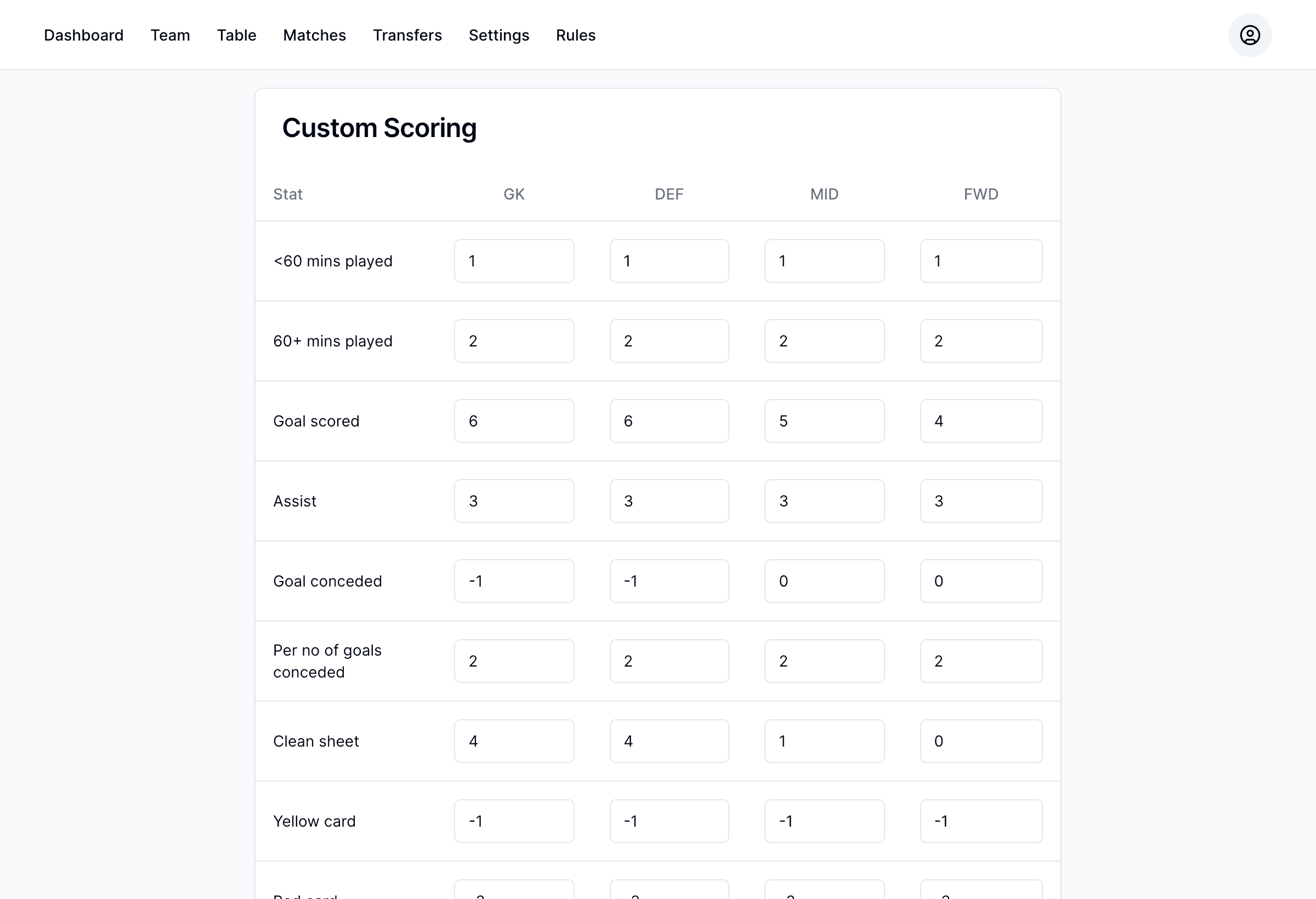
Draft Fantasy leagues can go further than fixed scoring. League creators can customise the values and thresholds for defensive contributions by position, alongside tackles, interceptions, BPS and other actions. That lets your group decide how heavily defensive work should count.
Create a Premier League league with custom scoring.
FPL defensive contributions: quick answers
Are defensive contribution points in FPL for 2026/27?
Yes. The Premier League confirmed on 20 July 2026 that the mechanic remains for the 2026/27 season.
How many DEFCON points does a player earn?
A player who reaches the relevant match threshold earns two FPL points. The award is capped at two points per match.
What is the defender threshold?
A defender needs 10 combined clearances, blocks, interceptions and tackles in a single match.
What is the midfielder or forward threshold?
A midfielder or forward needs 12 combined clearances, blocks, interceptions, tackles and ball recoveries in a single match.
Where can I compare FPL defensive contributions?
Use the free FPL DEFCON rankings and comparison tool to analyse qualifying actions and how regularly players reach their positional threshold.
Want a league where defensive scoring is yours to configure? Start a 2026/27 Premier League Draft Fantasy league.