Auction Fantasy Football: How the Draft Works and a £250 Strategy
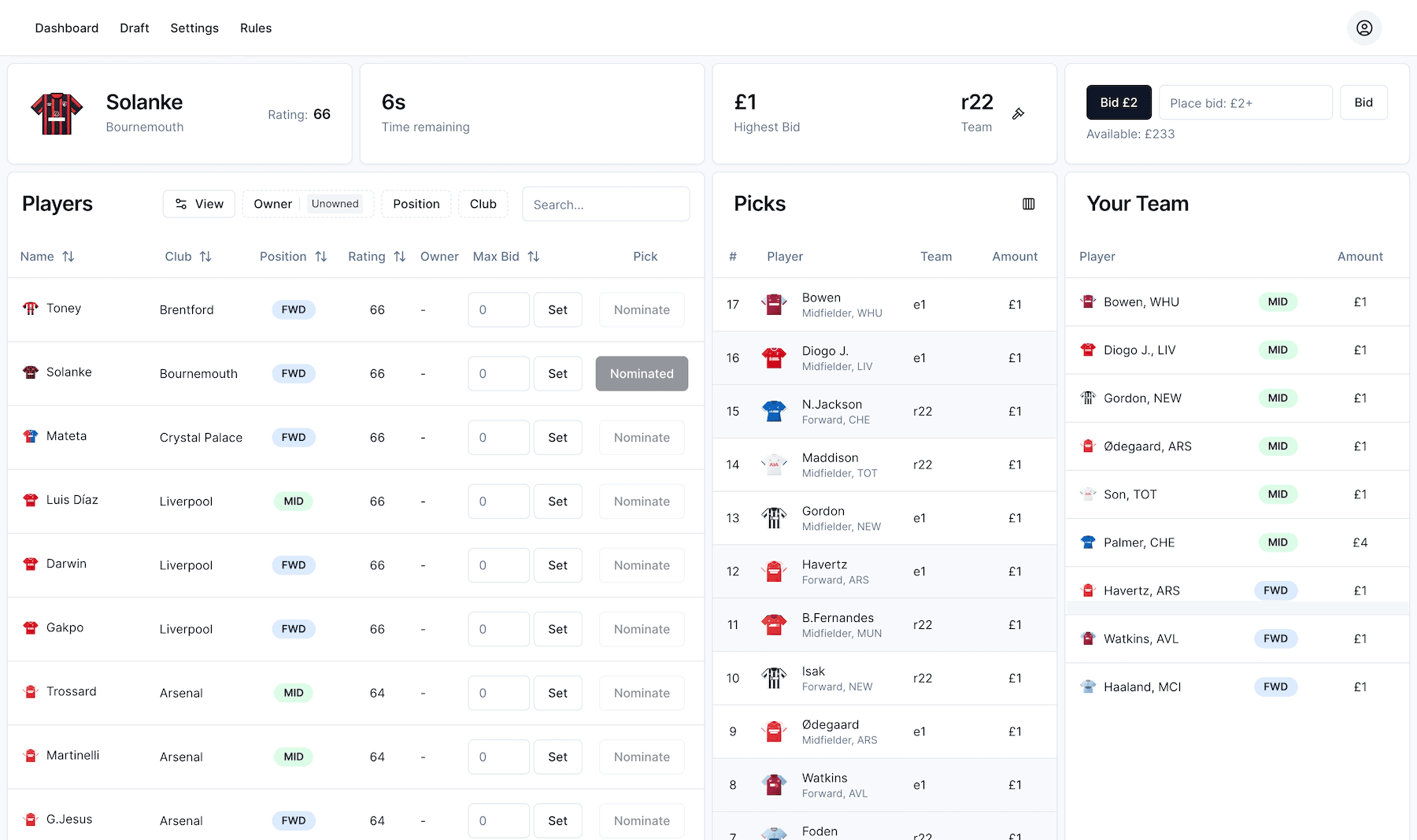
In auction fantasy football, every manager starts with the same budget and can bid for every player. The highest valid bidder wins the player, the fee comes out of that manager's balance and no rival can own the same player. Draft Fantasy Premier League runs this format with live bidding and unique squads.
That removes the luck of drawing first in a snake draft, but replaces it with a harder question: how much of your £250 should you spend now, knowing every pound has an opportunity cost later?
This guide explains the Draft Fantasy auction, uses comparable eight-manager bids to show how the market behaves and gives you a complete £250 budget plan for draft night.
How does an auction fantasy football draft work?
A Draft Fantasy auction has two phases for each player:
- Nomination. The manager whose turn it is chooses an available player. That manager automatically opens the bidding at £1.
- Bidding. Every manager can bid. When the timer expires, the highest valid bidder signs the player and pays the winning amount.
The nomination order reverses each round, just like a snake draft, and skips teams whose squads are already full. The auction ends when every manager has filled the squad size configured for the league.
The important difference from salary-cap fantasy is that there are no fixed player prices. Erling Haaland does not cost the same in every league. He costs whatever the second-most determined manager in your room makes the winner pay.
The important difference from a snake draft is access. There is no first pick that gives one manager exclusive access to the top player. Every manager can bid; budget and judgment decide the winner.
Create a Premier League auction league and invite your managers before setting the draft time.
The £250 budget rule that prevents a broken squad
You cannot spend your whole balance while places remain empty. Every bid must leave at least £1 for each squad place you will still need to fill after the purchase.
For a standard 15-player squad, that means your maximum opening bid is £236: the £250 budget minus £14 reserved for the other players. If you have £80 left and five empty places, the most you can bid for the next player is £76, because four further places still need £1 each.
Draft Fantasy enforces that limit. Your job is to understand it before a late bidding war makes the decision for you.
League settings can also change the permitted squad shape and maximum players per club. Check those settings before building a budget sheet; a plan for a standard 15-player Premier League squad will not transfer perfectly to every custom league.
What did top players cost in eight-manager auctions?
There are not yet four completed 2026/27 auctions that match this guide's assumptions: eight human managers, regular scoring and 15-player squads. Results from two-, three- and four-manager rooms are not comparable, so we do not present them as the current eight-manager market.
The best baseline is the 2025/26 market. These are average winning bids from four qualifying eight-manager Draft Fantasy auctions. They are observations, not fixed prices or instructions. Custom-scoring leagues can produce a different order and different bid ceilings.
| Player | Position | 2025/26 average | Share of £250 |
|---|---|---|---|
 Mohamed SalahLIV Mohamed SalahLIV | Midfielder | £118.30 | 47.3% |
 Erling HaalandMCI Erling HaalandMCI | Forward | £106.80 | 42.7% |
 Cole PalmerCHE Cole PalmerCHE | Midfielder | £104.00 | 41.6% |
| Alexander IsakLIV | Forward | £82.50 | 33.0% |
 Bukayo SakaARS Bukayo SakaARS | Midfielder | £81.30 | 32.5% |
| Viktor GyökeresARS | Forward | £70.00 | 28.0% |
 Bruno FernandesMUN Bruno FernandesMUN | Midfielder | £62.80 | 25.1% |
| Florian WirtzLIV | Midfielder | £60.50 | 24.2% |
 Ollie WatkinsAVL Ollie WatkinsAVL | Forward | £60.50 | 24.2% |
 Jarrod BowenWHU Jarrod BowenWHU | Forward | £40.00 | 16.0% |
2025/26 averages from four comparable eight-manager auctions.
The useful signal is not one exact price. It is the shape of the market.
The three most expensive players all consumed more than 40% of one manager's starting budget. Haaland averaged nearly £107, and an individual room can go much higher. If you want him, plan for a genuine three-figure bid rather than building around a bargain anchor price.
You can build a squad around one of those spends. Trying to win several of them is where the rest of the roster becomes fragile. The alternative is to leave the £100 tier alone and buy multiple players from the £50–£85 range.
Use the live 2026/27 draft cheat sheet to compare player tiers and positional scarcity before assigning your own ceilings. The current striker rankings explain the most expensive position, while the goalkeeper guide shows where a patient manager can preserve budget.
A £250 budget with one elite anchor
There is no universally correct allocation because your room and scoring settings create the market. You still need a starting plan. This example covers a standard 15-player squad and spends every pound:
| Squad group | Players | Group budget | Purpose |
|---|---|---|---|
| Elite anchor | 1 | £110 | Compete for one of the few players who can clear £100 |
| Other forwards | 2 | £30 | Prioritise secure starters over famous names |
| Top midfielders | 2 | £35 | Two starters from the tiers below the elite bids |
| Other midfielders | 3 | £25 | Tier value plus one upside pick |
| Premium defender | 1 | £15 | Pay only when the player separates from the position |
| Other defenders | 4 | £25 | Depth, secure minutes and rotation options |
| Goalkeepers | 2 | £10 | One starter and one inexpensive alternative |
This is a decision framework, not a shopping list. If Haaland reaches roughly last season's £107 average, the plan barely changes. If the room pushes him to £130, find £20 of reductions before bidding rather than hoping the arithmetic fixes itself later.
If your anchor is Fernandes around last season's £63 average, you can move the spare money to a second forward or a premium defender. If the room pushes every famous attacker beyond your ceilings, abandon the anchor line entirely and buy several players from the next tiers.
Seven auction strategies that protect your budget
1. Set a ceiling, not a prediction
You do not need to predict the exact winning bid. Decide the highest amount at which the player still improves your whole squad. £40 can be a fair forecast and a bad bid if your ceiling is £34.
Write ceilings for tiers, not just names. If two forwards project similarly, the cheaper one should usually win your decision.
2. Pay for scarcity
Raw projected points do not tell you what a player is worth in a unique-player league. The gap to the replacement at the same position matters more.
That is why an elite forward or unusually dominant defender can justify more than a similarly projected midfielder. The midfielder pool may still offer several alternatives; the forward pool may not.
3. Use one anchor as a choice, not a reflex
A stars-and-scrubs build can work, but call it before the draft. Spending £100–£120 on one anchor is manageable only when the rest of the budget is planned around it. Doing it once, then improvising another £50 purchase, is how managers reach the final places with no flexibility.
Choose the player whose edge is worth reshaping the squad. Let the other stars go when the room crosses your ceilings.
4. Nominate with a purpose
A nomination opens at £1, so never nominate a player you would be unwilling to own.
Early in the draft, nominate an expensive alternative when you want rivals to commit budget. Nominate your own target when the managers most likely to compete have already spent heavily or filled that position. The player pool matters, but remaining balances and open squad places tell you who can actually challenge.
5. Let max bids do the work
You can set a max bid before or during the draft. Draft Fantasy raises the current price only as much as needed, up to your limit.
If your max is £50 and the current bid is £41, the system can bid £42 rather than jumping straight to £50. When several managers have max bids, the leading manager pays only enough to beat the next-highest valid maximum, without exceeding their own ceiling.
Max bids are especially useful if you cannot stay online for the whole auction. If your nomination timer expires, Draft Fantasy first looks for a valid player with your highest max bid; otherwise it nominates the highest-rated valid player.
6. Do not bid merely to make a rival pay
Price enforcement sounds clever until everyone else stops. Then the player and the bill are yours.
Only make a bid that still works for your squad. You can benefit when a rival overspends without being the person who creates the overspend.
7. Recalculate after every win
A £10 bargain is not just a bargain. It is £10 you can add to another ceiling. A £10 overpay must come out of another group.
Track four things after every purchase:
- remaining balance;
- empty squad places;
- minimum £1 reserves;
- your revised budget by position or tier.
That habit matters more than entering the room with a perfect spreadsheet.
How the auction timer works
The commissioner chooses the time per pick; 30 seconds is the standard quick option, with 60 seconds, two minutes, five minutes and custom slow-draft times also available.
A bid made with fewer than ten seconds remaining resets the clock to ten seconds. A bid with more time left does not shorten the clock. That anti-snipe rule gives every manager a fair chance to respond.
When the bidding timer expires, the highest bidder wins. When a nomination timer expires, Draft Fantasy automatically selects a valid player for that manager, prioritising their highest max bid before the platform rating.
What happens to money left after the draft?
By default, nothing. Auction money is for the draft and has no value after every squad is full.
There is one configurable exception. In a league with FAAB waivers, the commissioner can set an Auction leftover → FAAB rate. At a rate of 1, £20 left becomes £20 of waiver budget. At a rate of 2, it becomes £40.
Check that setting before draft night. Spending down to £0 is rational when leftover money disappears; preserving a small balance can be rational when it strengthens your in-season waiver budget.
Auction fantasy football FAQs
Is an auction draft fairer than a snake draft?
It removes draft-order luck because every manager can bid for every player. It does not make every outcome equal: managers who value players and manage the budget better should finish with stronger squads. That is the point of the format.
Does every player start at £1?
Yes. The nominating manager places the opening £1 bid. Other managers can then raise it until the timer expires.
Can two managers own the same player?
No. Each player has one owner in a league. Once the auction is complete, rivals need a trade or must wait until that player becomes available.
Can I spend all £250 on one player?
No. A valid bid must preserve at least £1 for every squad place that will remain empty. In a 15-player squad, the theoretical maximum first purchase is £236.
What if I cannot attend the auction?
Set max bids in advance. Draft Fantasy can bid up to those limits and uses them when it needs to nominate automatically for you. Review enough players to cover every position and leave alternative options in each tier.
Do these prices work with custom scoring?
Treat them as context only. The observed averages above come from regular-scoring leagues; custom scoring can materially change player values. Use your league's own player points and settings before copying any ceiling.
Build your auction league
Start with one anchor decision, assign the other £140 or more across the squad and write an exit price for every tier. Then react to the room without abandoning the arithmetic.
Use the free Premier League draft cheat sheet to build the board, then create your 2026/27 auction league, invite your managers and schedule the draft.