Fantasy Football Waivers Explained: FAAB, Rolling and Weekly Reset
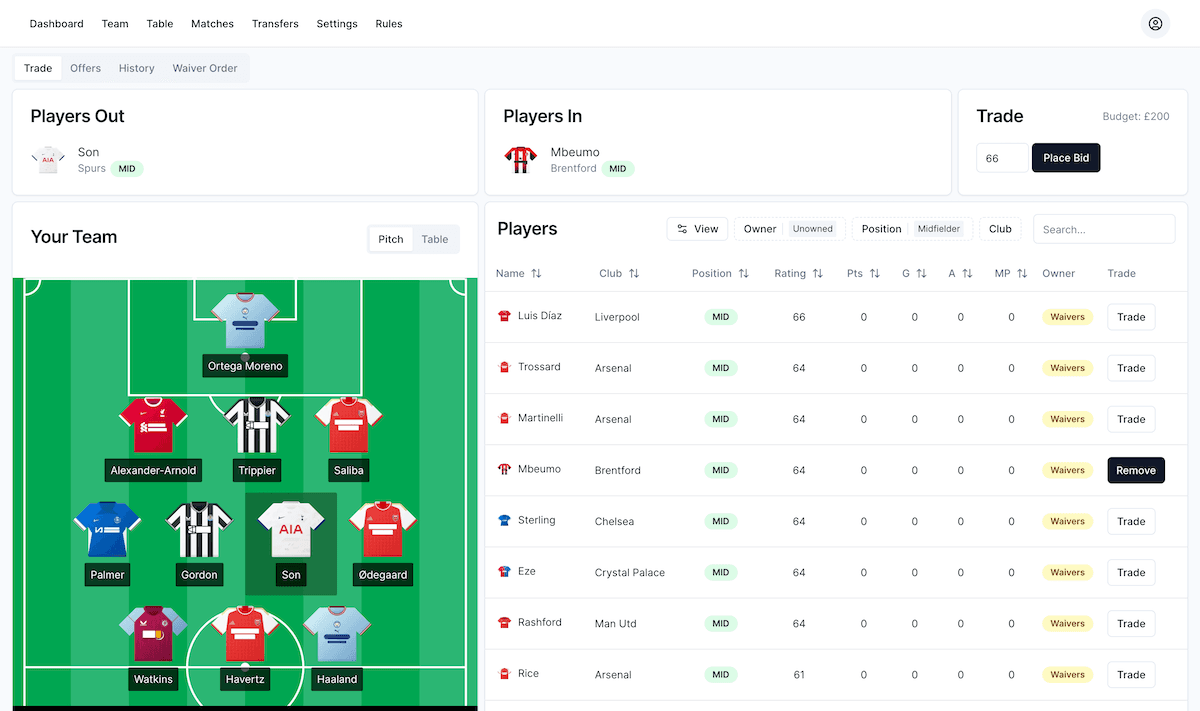
A fantasy football waiver system gives every manager a fair chance to claim an unowned player. Instead of rewarding whoever clicks first, the game holds eligible players on waivers, accepts claims and awards each player when the next waiver window is processed.
The important decision is how competing claims are ranked. A league can use a budget, a continuing priority queue or a queue that resets each Gameweek. Draft Fantasy Premier League supports all three systems, plus the option to turn waivers off.
The four waiver formats at a glance
| Format | Who wins a contested claim? | What changes after a successful claim? | Best for |
|---|---|---|---|
| FAAB | Highest bid; waiver order breaks equal bids | Winning bid is deducted and the manager moves to the back of the queue | Competitive leagues that want every manager to value each pickup |
| Rolling | Manager highest in the current queue | Winner moves to the back of the queue | Simple leagues that want priority to carry forward |
| Weekly reset | Manager highest in a queue reset to reverse standings each Gameweek | Winner moves back after the claim, then the queue resets next Gameweek | Social leagues that want to help struggling teams |
| None | There is no waiver contest | Unowned players are handled as first-come, first-served free agents | Casual leagues comfortable rewarding speed and availability |
Our default recommendation is FAAB. It asks the right question: not just “Do I want this player?”, but “How much of a limited season budget is this player worth?” Every manager can compete for a breakout player, while saving budget creates an advantage later.
Create a Premier League league and choose your waiver format.
What is FAAB in fantasy football?
FAAB stands for Free Agent Acquisition Budget. In Draft Fantasy, every team in a FAAB league begins with £200 for the season. Managers enter a whole-number bid, including £0, when making a waiver request. The highest valid bid wins and only a successful bid is deducted from the manager's budget.
If two managers submit the same bid for the same player, the manager higher in the waiver order wins. A successful claim then moves that manager to the bottom of the queue, so the queue remains a meaningful tiebreaker.
FAAB is the strongest all-round choice because it separates opportunity from urgency. The manager who is last in the table does not automatically receive every emerging player, and the manager currently first in the queue does not need to spend that priority on a modest upgrade. Everyone makes a valuation decision.
A practical FAAB approach
Treat £200 as a season-long resource rather than 20 equal weekly allowances.
- Use £0 bids for replaceable depth. You can still win when nobody else bids.
- Spend more when the role can last. A new first-choice starter is more valuable than a one-match injury replacement.
- Keep alternatives in your request list. Missing your first target should not leave an obvious squad problem unresolved.
- Preserve late-season flexibility. Cup runs, postponed fixtures and injuries can create valuable pickups after impatient managers have exhausted their budgets.
Draft Fantasy commissioners can also allow FAAB to be included in player trades. In an auction league, they can choose whether leftover draft money converts into FAAB when the draft finishes. The auction fantasy football guide explains why unspent draft budget still has an opportunity cost before any conversion is applied.
How rolling waivers work
A rolling waiver queue has no weekly reset. The manager at the front has first priority when claims compete. After a successful claim, that manager moves to the back; managers who do not win keep their relative position.
Rolling waivers reward patience. Passing on a small upgrade protects first priority for the next major signing or unexpected starter. The trade-off is that holding the top position can become too powerful: managers may avoid useful moves because they are waiting for a perfect claim.
Choose rolling waivers when your league wants a rule that is easy to understand but still rewards long-term planning. It works especially well when managers are similarly active and everyone accepts that priority is itself an asset.
How weekly-reset waivers work
Weekly-reset waivers reorder the queue at the start of each Gameweek, placing the lowest team in the standings first. A successful claim still sends its manager to the back during that claim run, but the standings create a new order at the next reset.
This is the most forgiving format. A struggling team repeatedly receives the first chance to improve, which can keep a head-to-head league competitive. It also reduces the value of saving priority: a manager near the bottom can make a successful claim and return near the front after the next reset.
Choose weekly reset when league balance matters more than preserving waiver priority as a strategic resource. It is often a good fit for a mixed-experience group or a league where keeping every manager engaged is the main objective.
What happens when waivers are turned off?
With no waiver system, unowned players are free agents. A manager can add an eligible free agent immediately, subject to the league's squad, formation and maximum-players-per-club rules.
That is simple, but it rewards notification speed, time zones and availability. A manager watching a match can react to a goal or injury before someone who is working or asleep. Turning waivers off is reasonable for a casual league, but it is rarely the fairest setting for an active competitive group.
How to make a waiver claim
A Draft Fantasy waiver request is a one-for-one move: select the player you want to add and the player you will drop. You can submit several requests and arrange them in your preferred order. In a FAAB league, you can also edit each bid before processing.
When the waiver window runs, Draft Fantasy works through valid requests in this order:
- FAAB amount, when the league uses bidding;
- the league's current waiver order; and
- each manager's own request priority.
Once a player is awarded, competing requests for that player are rejected. The winning manager receives the player, the outgoing player is placed on waivers, and the next valid request is considered. A claim can fail if another manager has already won the target, the manager no longer has enough FAAB, or the resulting squad would break league rules.
For Premier League competitions, standard waiver processing runs on Tuesday and Friday at 10:00 UTC. Fast-moving tournament competitions can add extra processing mornings, so use the schedule shown inside your league rather than assuming every competition follows the Premier League timetable. Product rules and schedule checked on 11 August 2026.
Waivers, free agents and trades are different
- A waiver claim competes for an unowned player during a holding period.
- A free-agent pickup adds an immediately available unowned player on a first-come basis.
- A trade is an offer between managers for players already owned by their teams.
Waivers solve fairness at the moment demand spikes. Free agency keeps the transfer market usable between processing windows. Trades let managers negotiate for players who will never reach the unowned pool.
Which waiver system should your league choose?
Use this commissioner rule of thumb:
- choose FAAB for the deepest strategy and the fairest access to every contested player;
- choose rolling for a simple queue that rewards restraint;
- choose weekly reset to give lower-ranked teams the strongest route back; or
- choose none only when your group prefers instant pickups to equal access.
Agree the format before draft night and explain the consequences, especially the FAAB tiebreaker and the weekly-reset rule. Managers will accept losing a claim when they understand the system; changing it after a valuable player appears creates avoidable disputes.
Ready to set the rules? Start a Draft Fantasy Premier League league, invite your managers and choose FAAB, rolling, weekly-reset or no waivers before the season begins.