How Auto Subs Work in Draft Fantasy Football
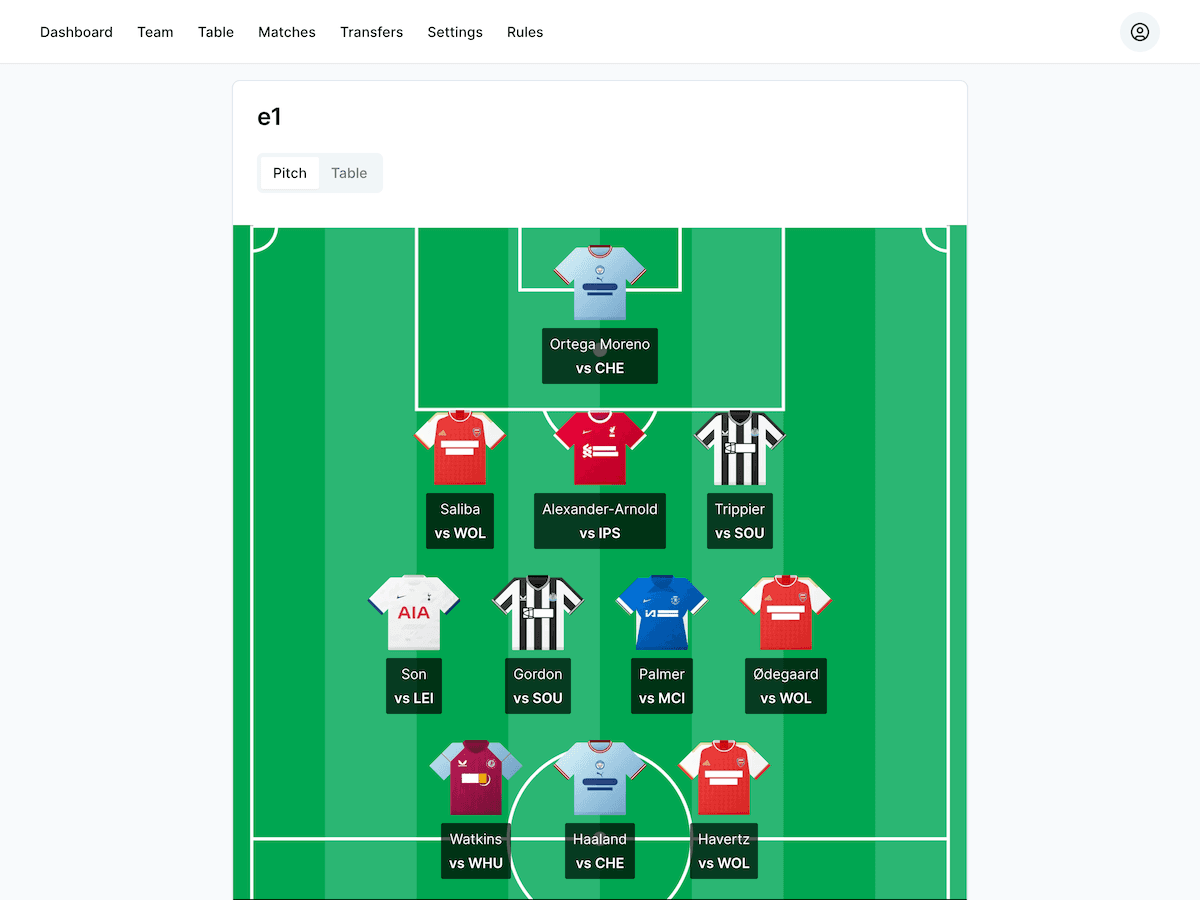
Auto subs in Draft Fantasy replace a starter who records no minutes with the first substitute who played and can enter without breaking your league's formation rules. A one-minute appearance is enough to keep the starter in your lineup, while a bench player who records no minutes cannot come in.
This guide covers Draft Fantasy Premier League, an independent draft game rather than the Premier League's official FPL Draft. The commissioner can turn auto subs on or off, and custom lineup rules can change which replacement is valid.
The auto-sub rule in one checklist
An automatic substitution happens only when all four conditions are true:
- Auto subs are enabled. They are on by default, but the commissioner can disable them in league settings.
- A starter records no minutes. Any recorded playing time means that player stays in the scoring lineup.
- A substitute records minutes. A bench player who did not play is ignored.
- The replacement leaves a valid formation. The final lineup must still satisfy the league's minimum and maximum players at each position.
Draft Fantasy checks the available substitutes in the order you set. It uses the earliest one who played and produces a valid lineup. If the first substitute cannot fit, the system can move on to a later eligible player.
That makes bench order a real decision, not a cosmetic list. Put the player whose points you most want first, but check whether your current formation would actually allow that player to replace a likely absence.
Does an auto sub need to play the same position?
No—not always. The replacement needs to preserve a valid formation, not necessarily share the absent player's position.
Imagine a standard 3-4-3 lineup. If a midfielder records no minutes, a defender first on the bench can replace him because the result is a valid 4-3-3. A midfielder would also fit, so your bench order decides which eligible player is considered first.
Now reverse the problem. If one of the three starting defenders records no minutes, a midfielder cannot replace him: the team would fall below the standard minimum of three defenders. The system skips that midfielder and can use a later defender who played.
A goalkeeper is the clearest case. Standard lineups require exactly one, so an absent starting goalkeeper needs an eligible bench goalkeeper.
The usual Draft Fantasy defaults are 11 starters, four substitutes, one goalkeeper, three to five defenders, two to five midfielders and one to three forwards. Commissioners can change the lineup size, bench size and positional limits, so your own league settings are the final authority. The fantasy football league settings guide explains when those controls are worth changing.
Three examples that settle most disputes
Your starter plays one minute
The starter remains in the lineup. Auto subs test whether a player recorded any minutes, not whether he started, reached 60 minutes or scored points. A late cameo can therefore block a high-scoring bench player.
Your first substitute plays but would break the formation
Draft Fantasy checks the next bench option. The first substitute is not forced into an invalid lineup, and a later player can enter if he recorded minutes and satisfies the positional limits.
Two starters do not play
The same process can create two replacements. Each bench player can be used only once, and every change must leave the evolving lineup valid. This is why ordering playable cover across more than one position is safer than loading the bench with players who all solve the same problem.
When are auto subs added to the score?
Auto subs are finalized after the Gameweek ends. During live matches, the team page can show them as pending; the completed list then shows who came in and who went out.
Do not treat a live head-to-head score as final when a starter has no minutes and an eligible substitute is waiting. The replacement and updated team points are settled when the Gameweek is processed.
Regular and custom scoring can value the substitute's performance differently, but they do not change the auto-sub eligibility test: recorded minutes, bench order and a valid formation decide who enters.
How to set your bench order
Use this sequence before the Gameweek:
- Check the commissioner setting. If auto subs are off, no bench order can rescue a missing starter.
- Rank the bench by expected value. Put the player you would most want to count first.
- Test the formation. Ask whether that player can replace each doubtful starter while keeping every positional minimum.
- Protect specialist positions. A bench goalkeeper cannot cover an outfielder, and an outfielder cannot cover the goalkeeper slot under standard rules.
- Prefer likely minutes. Upside does not help if the substitute also records no playing time.
- Recheck the team page after the Gameweek. The auto-subs section shows the finalized in-and-out pairs.
The practical rule is simple: order your bench for points, then audit it for formation coverage.
Create a Draft Fantasy Premier League league and choose your auto-sub and formation rules. Each footballer has one owner in your league, so the bench you draft and the cover you find on waivers remain part of the weekly strategy.
Auto-subs FAQ
Why did my bench player not replace a starter?
The usual reasons are that the starter recorded some minutes, the bench player recorded none, the replacement would have broken a formation rule, or the commissioner disabled auto subs.
Does a starter have to reach 60 minutes to avoid an auto sub?
No. Any recorded minutes count as playing. The 60-minute mark matters to some scoring events, not to auto-sub eligibility.
Can my second or third substitute come in before my first?
Yes. An earlier substitute can be skipped if he did not play or cannot enter without breaking the formation. Draft Fantasy then checks the next eligible bench player.
Are auto subs on by default?
Yes. A commissioner can turn them off in league settings.
Set the rule before the season and make it visible to every manager. Then start your Draft Fantasy Premier League league with a bench system the whole group understands.