Best Fantasy Football League Settings: A Commissioner’s Guide
The best fantasy football league settings are the ones every manager understands before the draft. For a first Draft Fantasy Premier League season, start with eight managers, 15-player squads, head-to-head scoring, regular points, FAAB waivers, trades and auto-subs. Choose snake for the simplest draft or auction when everyone wants equal access to every player.
That setup is competitive without making the rules the main event. Draft Fantasy Premier League lets the commissioner adjust each part, so experienced groups can build something deeper after agreeing what they want to reward.
A ready-to-use league setup
Here is the baseline I would use for an eight-manager group playing together for the first time:
| Setting | Recommendation | Why it works |
|---|---|---|
| Visibility | Private | The invite link keeps the league to your group. |
| Managers | 8 | The player pool stays deep enough for waivers while every squad still has trade value. |
| Draft | Snake for simplicity; auction for control | Snake is quicker to learn. Auction gives every manager a chance to bid on every player. |
| Pick timer | 30–60 seconds | Enough time for a live decision without turning the draft into an evening of waiting. |
| Table | Head-to-head | Every Gameweek produces a direct matchup, win, draw or loss. |
| Squad | 15 players: 11 starters and four substitutes | Familiar lineup decisions with enough bench cover. |
| Scoring | Regular scoring | It matches official FPL scoring and gives everyone a known starting point. |
| Waivers | FAAB | Every manager can bid rather than depending on a fixed queue position. |
| Trades | Enabled | Unique ownership makes negotiation part of the game. |
| Auto-subs | Enabled | A valid bench player can replace a starter who does not play. |
| Maximum per club | 3 | It spreads exposure across Premier League teams. |
| Playoffs | Off for season one | The full-season table decides the champion without changing the stakes late on. |
This is an editorial recommendation, not a required Draft Fantasy preset. A six-manager family league, a 14-manager expert league and a slow draft spread across several time zones need different settings.
Scoring basis: the recommendation uses Draft Fantasy regular scoring, which matches official FPL scoring. Custom-scoring leagues calculate points from the commissioner’s values, so player rankings, positional scarcity and sensible auction bids can change.
Decide draft type, league size and squads first
Some settings shape the entire player market. Agree them before anyone prepares a shortlist.
Snake or auction draft?
A snake draft reverses the order each round. If you pick first in round one, you pick last in round two. It is easy to follow and does not require managers to price every decision.
An auction draft starts each manager with £250. Players are nominated one at a time and managers bid from that budget. The advantage is access: draft position never prevents you from trying to sign the player you value most. The cost is opportunity—every pound won on one player is unavailable for the rest of your unique squad.
For the eight-manager, 15-player, regular-scoring setup above, choose snake when several managers are new or the group wants a shorter learning curve. Choose auction when the live bidding is part of the appeal. The auction fantasy football guide explains nominations, reserve money, maximum bids and budget planning in detail.
How many managers should join?
League size controls replacement level. A 15-player squad means:
- eight managers draft 120 players;
- ten managers draft 150; and
- 12 managers draft 180.
That arithmetic changes every later decision. Larger leagues make late picks, backups and trades more important because fewer starters remain unowned. Smaller leagues produce a stronger free-agent pool and make mistakes easier to repair.
Eight is a useful first-season balance, not a magic number. If your group has ten committed managers, do not exclude two people merely to copy a template. Commitment matters more than theoretical balance.
Keep the first squad rules recognisable
An 11-player lineup and four-player bench create a 15-player squad. The standard position limits still leave room for different formations while preventing a manager from filling the squad with only one outfield position.
Draft Fantasy can change lineup size, bench size, minimum and maximum players by position, and the maximum number from one club. Those controls are useful for specialist formats, but changing several at once can create a player-pool problem. Before saving a custom squad, multiply the squad size by the number of managers and check that each positional requirement is realistic.
Choose how the season is won
Head-to-head and total-points tables reward different kinds of success.
In a head-to-head league, each manager faces an opponent every Gameweek. A win earns three table points and a draw earns one. This creates weekly stakes and keeps attention on the schedule as well as the season total.
In a classic points league, the table is ordered by total fantasy points. It is the cleaner test of season-long scoring because one poor week cannot become a loss simply because it happened against the league’s highest scorer.
For a social league, I prefer head-to-head. For a group that wants the strongest total squad to win with less matchup variance, choose classic points.
Draft Fantasy also supports a draw threshold for head-to-head matches. Leave it empty when only equal scores should draw. A threshold can reduce results decided by a tiny points gap, but it also means two different fantasy scores can count as level; write that rule in the league chat before the season begins.
Playoffs add a late knockout finish for the leading teams, while the final Gameweek setting controls when the league stops counting. These are excellent tools for groups that want a final, but a first-season league is easier to understand when the table itself crowns the champion.
Start with regular scoring, then test one idea
Regular scoring is the safest baseline because managers can prepare with the familiar values for appearances, goals, assists, clean sheets, saves, cards, bonus and defensive contributions. The 2026/27 scoring guide shows those values in one table.
Custom scoring is most useful when the league can state its goal in one sentence:
- “Make ball-winning midfielders draftable.”
- “Reward chance creation, not only the final assist.”
- “Give busy goalkeepers more value.”
- “Reduce the gap between positions.”
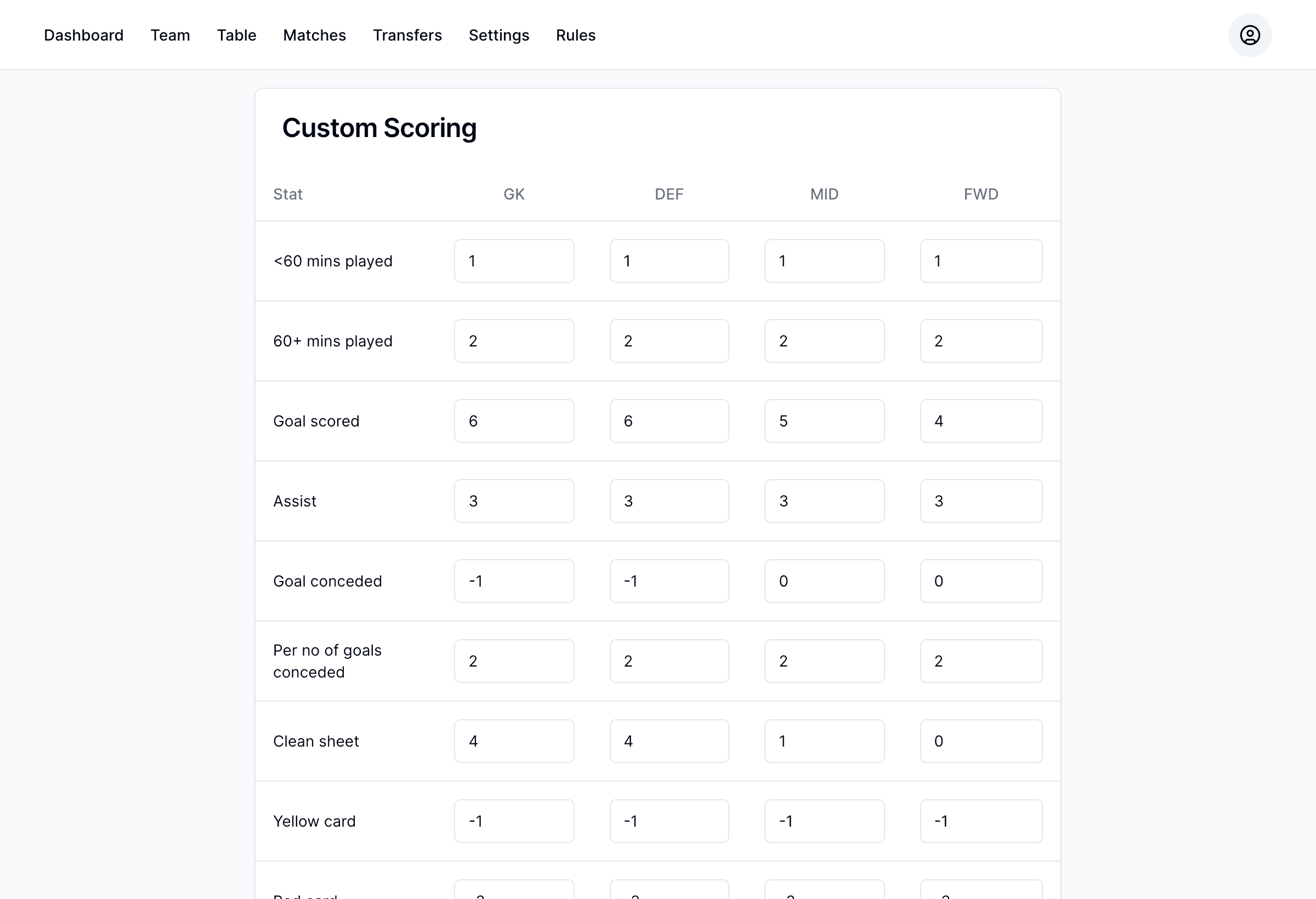
Draft Fantasy lets the commissioner set values separately for goalkeepers, defenders, midfielders and forwards. The editor includes headline events such as goals and clean sheets plus detailed actions such as key passes, tackles, interceptions, clearances, shots, aerial duels and expected goals.
The important step is to preview the effect, not merely like the idea. As values change, the custom-scoring impact panel recalculates real players, shows the change in points per game and reorders the list. Before the new season has match data, it can use the most recent completed season as the comparison. Check all players, then each position, and look for three warning signs:
- one action overwhelms every other route to points;
- a position moves far more than the league intended; or
- the total points per game rises or falls so sharply that ordinary performances become difficult to read.
Change one scoring concept, inspect the results, and only then add another. A testable rule is easier to explain and easier to reverse than a complete scoring system built from intuition.
Use FAAB waivers and keep trades open
Unique ownership means the post-draft market matters. FAAB gives each manager a £200 seasonal waiver budget and allows £0 bids. The highest bid wins, with the configured tiebreak rules resolving equal bids. That makes every manager eligible to compete for a new signing while forcing a decision about how much future flexibility to spend.
Rolling and weekly-reset queues are valid alternatives. Rolling rewards restraint because a successful claim moves the manager to the back. Weekly reset gives teams lower in the standings the first opportunity each Gameweek. Turning waivers off makes available players free agents immediately.
For a detailed comparison, use the fantasy football waiver rules guide. For the first-season template, I prefer FAAB because access depends on a manager’s bid rather than their fixed place in line.
Keep player trades enabled as well. Draft Fantasy squads are unique, so the trade market is the only direct route to a player another manager owns. In a FAAB league, the commissioner can also allow budget to be included in player trades. Auction leagues can convert leftover auction money into FAAB at a chosen rate; leave that option off unless everyone understands that conserving draft budget will carry an in-season reward.
Set the draft clock around the group
Draft Fantasy offers live pick presets from 30 seconds to five minutes, plus a custom timer that can support a slow draft. Public leagues must use a scheduled start; a private commissioner can schedule the draft or start it manually when everyone is ready.
Use 30 seconds when the group has prepared and wants a fast live event. Use 60 seconds when several managers are new. Use a slow custom timer only when the league has explicitly agreed to draft asynchronously; otherwise every pause feels like a technical problem rather than the format.
Run a mock draft before the real one if timing is uncertain. Empty mock-draft places can be filled by bots, so the commissioner can test the room, squad constraints and pace without creating a season league.
Commissioner checklist before starting the draft
Do not press start until the group can answer these questions:
- Is the draft snake or auction?
- How many managers and players are required?
- Is the table head-to-head or total points?
- Does regular or custom scoring apply?
- Which waiver system will process new signings?
- Are trades, FAAB trades and auto-subs enabled?
- Is there a maximum number of players per club?
- Do draw thresholds, playoffs or an early final Gameweek apply?
- When does the draft start, and how long is each pick?
Then publish the settings in one message. Managers should build rankings for the actual scoring and squad rules, not discover them when the first player is nominated.
Create a Premier League draft league and configure your rules. Set the format first, invite the group, and start only when every manager knows what they are trying to win.