The 2026/27 Fantasy Draft Cheat Sheet: Tiers, Scarcity and a Plan for Draft Night
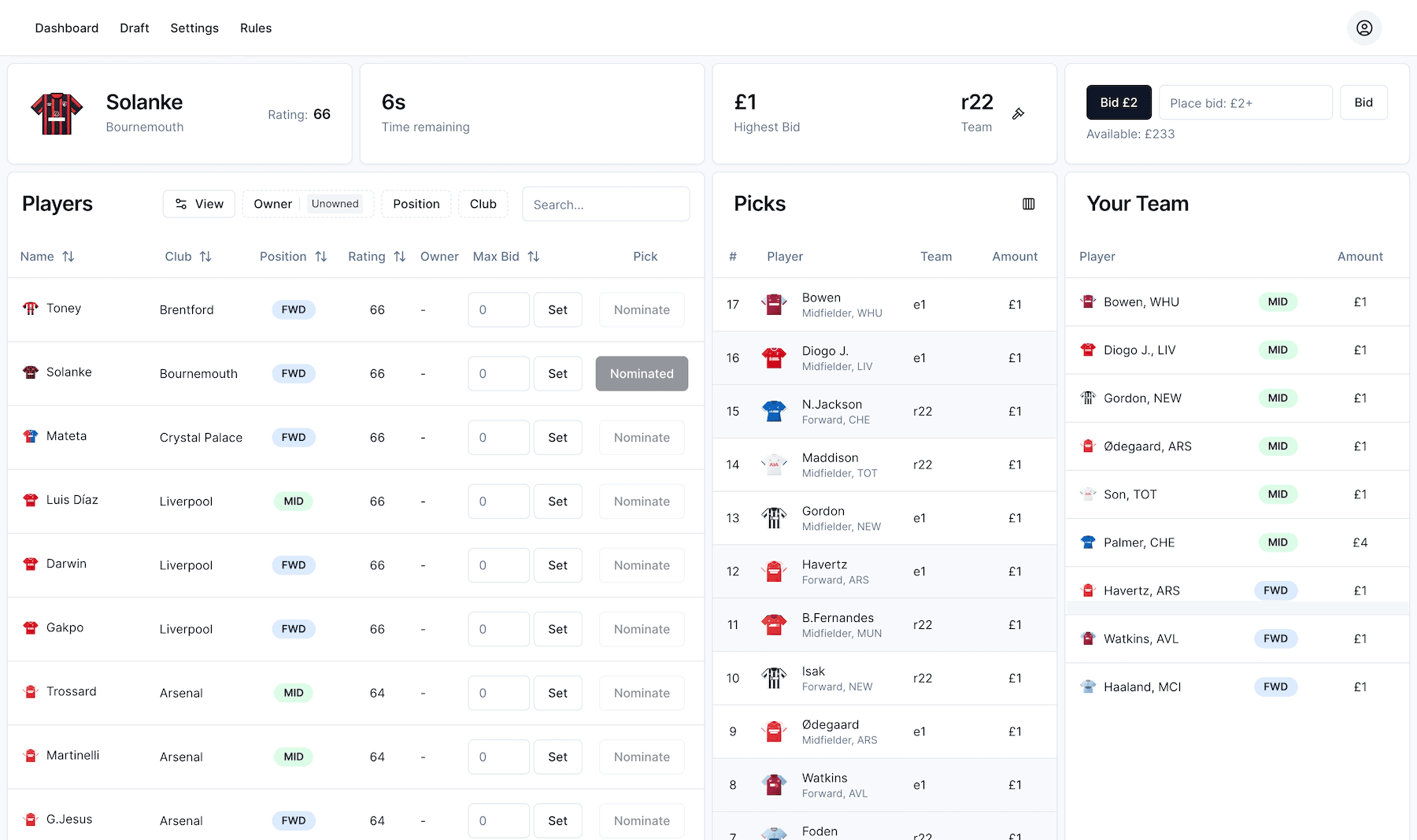
Draft night is the one evening of the fantasy season you cannot undo. Get it right and you spend four months trading from strength. Get it wrong and you spend four months chasing.
We built a free draft cheat sheet to make that evening easier: a tiered board of every draftable Premier League player, ranked in the order you should actually take them.
The Premier League season starts on 21 August 2026, and most leagues draft in the fortnight before it. This guide explains how to use the board and what to do with the picks it gives you.
First, which kind of draft do you mean?
Worth clearing up, because "draft" means two different things in fantasy football and only one of them needs a cheat sheet.
If you play the standard salary-cap game, your "draft" is a first attempt at a squad. Everyone can own the same players, you can change your mind for free until the deadline, and a ranking list matters far less than your budget.
In a draft league, each Premier League player can belong to only one manager. Managers take turns picking, and once a player is gone, he is gone for the season. There is no undo and no shared player pool. That is the format this cheat sheet is for, and it is the format Draft Fantasy for the Premier League runs.
Why this board is not ranked by projected points
Most rankings lists sort players by how many points they are expected to score. That is the wrong sort order for a draft, and it is the single most common way managers lose value early.
A draft is a competition for scarce players, not a shopping list. What matters is not how many points a player scores, but how many more he scores than the player you would otherwise have been stuck with at that position.
So our board ranks on exactly that: projected points above the last starter at that position in a league of your size. The tool calls this the Edge column, and you can set your league size from 6 to 16 managers so the maths matches your room.
The effect is that a scarce position rises and a crowded one falls. When we built the board, the replacement-level forward projected roughly 30 points fewer across the season than the replacement-level midfielder. That gap is why a forward can and should be taken ahead of a midfielder projected for more raw points: the midfielder is replaceable, the forward is not.
This is also why blanket rules like "never draft a goalkeeper early" can mislead you. Usually keepers do finish within a few points of each other, and the board will bury them accordingly. Occasionally one is projected far clear of the eighth-best, and then the board will say so. Read the number in front of you rather than the rule of thumb.
How to read the tiers
Every player sits in a tier within his position. Tiers do not break at round numbers; they break where there is an unusually large drop in projected points from one player to the next. A tier boundary is a real cliff.
That turns the board into a live decision tool rather than a list:
- Lots of players left in a tier? You can safely take a different position first and come back. The quality you get next round will be similar.
- One or two players left in a tier? If you want that position, take it now. After those players go, the drop is steep.
This is the whole skill of drafting, and it is why a tiered sheet beats a flat top-200 list. You are not trying to take the best player available. You are trying to take the position that is about to run out.
Filter the board to a single position and it regroups into tier bands so you can see the cliffs directly.
Create a Premier League draft league and put the board to work.
Six rules for draft night
Take the scarcity, not the name. Spend early picks where the drop behind the player is steepest. That is usually attackers, because far fewer of them are worth starting than midfielders. Two early attackers is a strong opening.
Do not stack one club. Three players from a strong side is fine. Five means one blank Gameweek, one bad run or one European hangover takes out a third of your team at once.
Be careful with players from the World Cup semi-finalists. Managers whose squads went deep into the summer often protect those players in the opening weeks. That is a genuine risk on a first-round pick and a genuine bargain in the later rounds.
Injured players are not off limits. A player due back within a month is routinely ignored by everyone else in the room. Our board keeps injured and doubtful players visible with a flag rather than hiding them, so you can make that call yourself. Note his return date and take him a couple of Gameweeks early.
Break ties with the opening fixtures. The board ranks on the full season deliberately, so the opening run does not distort it. But the First 5 column is there for your last few picks: when two players are close, take the one with the kinder start. Early points build trade leverage.
Gamble with your final picks. A defensive midfielder who returns two points most weeks wins you nothing. Late picks are free rolls. Take the player who might break out.
The draft is not the season
The most common mistake we see is not a bad draft. It is treating a good draft as finished business.
Plan for two things from day one:
Flex spots. You will not draft fifteen players you love. Keep a couple of squad places you are happy to churn every week and use them on whoever has the best matchup. In an eight-manager league there is always someone useful unowned. If one of them scores a hat-trick, he earns a permanent place.
Doubles and blanks. Later in the season, cup runs and postponements create Gameweeks where some clubs play twice and others not at all. Managers who plan two weeks ahead for these gain more than they ever gained on draft night. Keep an eye on the waiver schedule too, especially around Christmas when Gameweeks compress and claims can process the same night a Gameweek ends.
Draft Fantasy supports weekly reset waivers, rolling waivers, FAAB bidding or no waivers at all, plus trades between managers, so your league can decide how aggressive that in-season market should be.
Draft cheat sheet FAQs
Is the cheat sheet free?
Yes. The draft board is free and needs no account. It sits alongside our other free tools, including the points predictor, fixture difficulty ticker and defensive contributions tracker.
How often does it update?
The board refreshes automatically as player availability, squads and fixtures change, so it is worth a last look on the morning of your draft.
Does it work for other draft platforms?
Yes, with one caveat. The projections use Draft Fantasy's default scoring, which matches official FPL scoring for these categories. Any ranked board is only precise for the scoring it was built on, so if your league weights categories differently the order will shift. The tiers, the scarcity logic and the fixture columns still apply wherever you draft.
What if my league uses custom scoring?
Draft Fantasy leagues can change what goals, assists, clean sheets, saves, cards, defensive contributions and other actions are worth. The board uses default scoring, so if your league heavily rewards one category, adjust for it as you go, particularly in the middle rounds where players are closely matched.
Should I just auto-draft?
Auto-draft follows a preset order and will not react to what the room is doing. It is better than missing your pick, but a tiered board plus five minutes of attention beats it comfortably, because the value in a draft comes from noticing which position is about to fall off a cliff.
Get your league ready
Open the draft cheat sheet, set it to your league size, and work down it on the night.
Then create your 2026/27 Premier League league, pick a snake or auction draft, invite your friends and schedule draft night.