Fantasy Football Trade Strategy: 7 Tips for Draft Leagues
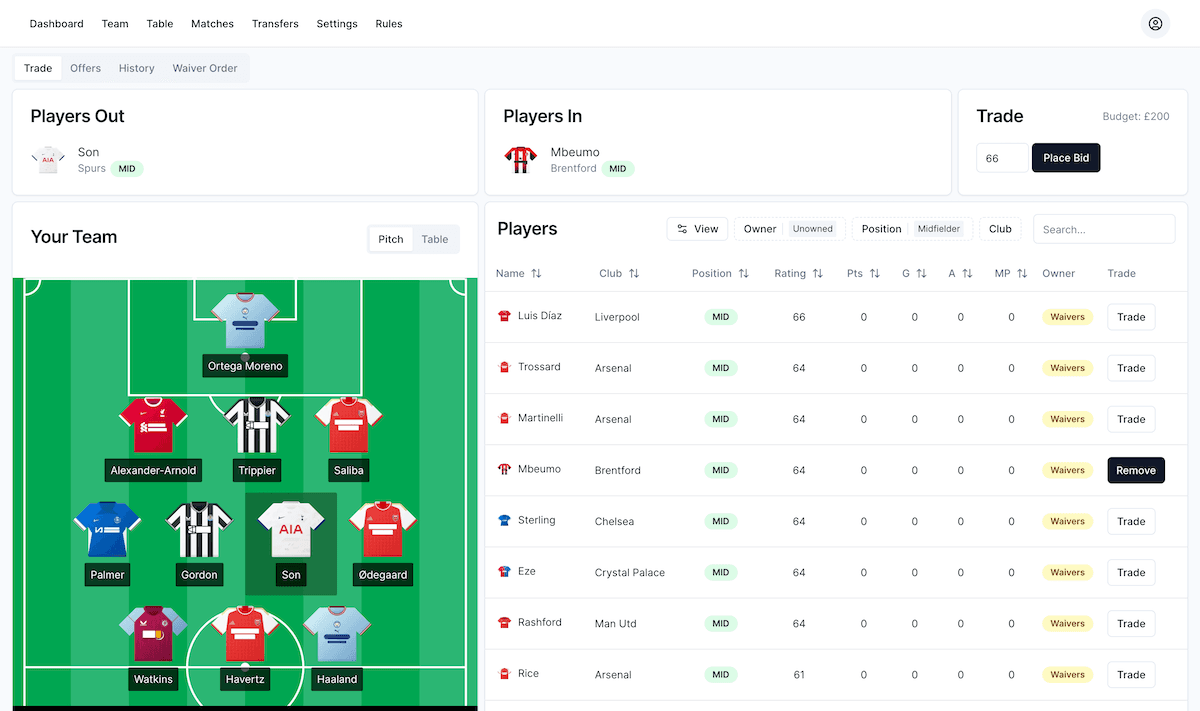
The best fantasy football trade solves a problem for both managers. Before sending an offer, compare five things: secure minutes, underlying involvement, the next three fixtures, positional scarcity and the best replacement each manager could get for free. Then offer a player who improves the other starting lineup—not two unwanted substitutes for one star.
That is especially important in a draft league, where every player has one owner. If a useful player is already rostered, negotiation is the only route to him. Draft Fantasy Premier League puts owned players, free agents, waivers and trade offers in one transfer market so you can compare those routes before giving up value.
Why trade now instead of chasing Gameweek 5 points?
Gameweek 5 is finished and data checked. The next deadline is 10:00 UTC on 10 October 2026, leaving an 18-day gap from this article's 22 September evidence snapshot. That is enough time to discuss a deal without pretending early team news is final—and too early to publish a confident Gameweek 6 waiver queue.
Use the gap to buy roles and schedules, not last weekend's score. A quiet player with five starts and strong expected involvement may be available at a discount. A high scorer may still be worth keeping when his minutes, defensive work and fixtures support the return.
Scoring note: the examples use Draft Fantasy regular scoring, which matches official FPL scoring. Custom-scoring leagues calculate points from commissioner-defined values, so extra rewards for shots, chances created or defensive actions can change every valuation.
Four current trade conversations to start
These are conversation starters, not universal trade prices. Roster rate estimates how often a player is already owned in completed private Draft Fantasy leagues. Expected goal involvement (xGI) is expected goals plus expected assists; it describes chance quality, not points owed in the future.
| Player | Pos | Rostered | Five-match evidence | GW6–8 | Approach |
|---|---|---|---|---|---|
 Igor ThiagoBRE Igor ThiagoBRE | Forward | 95.6% | 442 min · 10 pts · 3.29 xGI |
| Ask after the quiet points start |
 Kai HavertzARS Kai HavertzARS | Forward | 86.3% | 437 min · 19 pts · 2.04 xGI |
| Pay for the three-match run |
 Bryan MbeumoMUN Bryan MbeumoMUN | Midfielder | 94.8% | 450 min · 25 pts · 3.87 xGI |
| Test the owner before GW6 |
 James TarkowskiEVE James TarkowskiEVE | Defender | 88.3% | 450 min · 43 pts · 51 defensive contributions |
| Sell only for a real upgrade |
Official FPL and Draft Fantasy data, 22 September 2026; difficulty runs from 1 (easy) to 5 (hard).
Thiago is the clearest process discount. Five starts and 3.29 xGI have produced only ten regular-scoring points, while a 95.6% roster rate means he is unlikely to appear on waivers. The next three fixtures are not soft enough to justify an aggressive overpay, but they are reasonable enough to ask whether a frustrated owner prefers your steadier scorer.
Havertz is a schedule trade. He has played at least 437 of the first 450 league minutes, and Draft Fantasy rates each of Arsenal's next three matchups at difficulty two. Offer for three starts, not for a guaranteed goal.
Mbeumo combines both signals: every available minute, 3.87 xGI and a difficulty-one home fixture next. His owner has no reason to accept spare parts. A credible offer must solve a positional need or exchange one strong starter for another.
Tarkowski is the warning against automatic “sell high” advice. His 43 points sit well above 0.22 attacking xGI, but 450 minutes, 51 defensive contributions and two difficulty-two fixtures are evidence of a real floor. The harder Arsenal fixture in Gameweek 8 belongs in the price; it is not a reason to dump him.
1. Trade for your lineup, not your bench total
Start with the weakest place in your best XI. If you already have three reliable starting midfielders, another medium-value midfielder may add fewer weekly points than a dependable second forward—even when the midfielder has scored more so far.
Do the same calculation for the other manager. An offer becomes plausible when your surplus position fixes their starting lineup and their surplus fixes yours. “This helps both teams” should be visible from the squads, not merely asserted in a message.
2. Separate role, process and points
Current points are the outcome. Minutes and starts describe the role. xGI, defensive contributions and other repeatable actions describe the process behind the outcome.
Use all three layers:
- Role first: prefer a starter with stable minutes to a substitute who returned once.
- Process second: ask whether shots, chances or defensive work support future scoring.
- Points third: use the total to understand the owner's likely asking price.
Expected data does not promise regression. Thiago can keep missing, and Tarkowski can stop returning. The advantage is that you are making the uncertainty explicit instead of valuing every player from one score.
3. Price the next three fixtures—not only the next one
One easy matchup can make an offer expensive without changing the player's medium-term value. Three fixtures are long enough to reveal a useful schedule edge and short enough to matter to the manager receiving the player now.
The free fixture-difficulty tool lets you compare the same window for every player in your league. Use the displayed 1–5 model rather than guessing from club reputation, and check venue: a rating applies to that specific home or away fixture.
4. Compare the replacement each manager can actually add
A trade is not simply Player A versus Player B. It is:
Player A plus the best player you can add afterward versus Player B plus the player the other manager can add afterward.
That is why positional scarcity matters. Trading away your second playable forward can create a bigger loss than trading a similarly scoring fifth midfielder. Before accepting, open the transfer market and inspect the unowned pool in both positions.
If a comparable replacement is free, use a waiver or free-agent move instead of paying another manager. The fantasy football waiver guide explains when FAAB, rolling priority or a weekly reset determines that alternative cost.
5. Send one clear offer that the other manager could accept
A useful opening message is short:
You need a starting midfielder; I need a forward. Would you trade your forward for my midfielder? Both have secure minutes, and I prefer the forward's next three fixtures.
Name the mutual fit and the reason for your preference. Do not send several deliberately lopsided offers to discover how inattentive someone is. That reduces future negotiation and makes an active league worse.
In Draft Fantasy, each side of a bilateral trade must include the same number of players, and both resulting squads must satisfy the league's position and lineup rules. If you want to consolidate value, build a two-for-two package with one clear upgrade and one useful balancing player rather than proposing a two-for-one the product cannot accept.
6. Use FAAB to close a small value gap
Commissioners can allow FAAB in trades when the league uses FAAB waivers. If that setting is enabled, one side can include available FAAB with the player exchange.
Use it as a tiebreaker, not camouflage. If both managers agree the players are close but one side is giving up the scarcer position, a modest FAAB addition can balance the deal without forcing another player into it. If the player gap is large, adding budget does not turn an unhelpful offer into a fair one.
Create a Premier League draft league with trades and configurable waivers and make the transfer market part of the season, not just draft night.
7. Recheck the deal when it is accepted
Time changes value. Before accepting an offer, recheck availability, the latest role, the next deadline and whether every included player is still owned by the expected team. An offer that was fair when sent can become wrong after an injury or lineup change.
Draft Fantasy keeps sent and received deals in the Offers view. The receiving manager can accept or reject; the sender can cancel a pending offer. Keep the written league rule simple: managers may value players differently, but deliberate collusion is not a valid difference of opinion. Commissioners should publish that standard before the season rather than inventing it after a controversial deal.
The league-settings guide recommends enabling trades because unique ownership gives every manager another way to improve. It also explains how league size, squad depth and waiver format change the market around those trades.
The 30-second trade checklist
Before pressing send or accept, answer every question:
- Does the incoming player improve my starting lineup?
- Are his minutes and role secure enough for the price?
- What do the next three fixtures add or remove?
- Which position becomes scarce after the trade?
- Who is the best available replacement for each side?
- Does the other manager gain something they need?
- Would I still make this deal if last Gameweek's points were hidden?
Player points, minutes, xGI and event state came from official Fantasy Premier League data on 22 September 2026. The upcoming schedule came from the official fixtures feed. Draft Fantasy roster rates and model difficulty were joined to those records by player and fixture ID from the epl26 snapshot generated at 06:38 UTC.
Ready for a league where every negotiation changes two unique squads? Start a Draft Fantasy Premier League league, invite your managers and keep trades enabled.